Haven't signed into your Scholastic account before?
Create an accountTeachers, not yet a subscriber?
Subscribers receive access to the website and print magazine.
You are being redirecting to Scholastic's authentication page...
Haven't signed into your Scholastic account before?
Create an accountTeachers, not yet a subscriber?
Subscribers receive access to the website and print magazine.
You are being redirecting to Scholastic's authentication page...
Haven't signed into your Scholastic account before?
Create an accountTeachers, not yet a subscriber?
Subscribers receive access to the website and print magazine.
You are being redirecting to Scholastic's authentication page...
Haven't signed into your Scholastic account before?
Create an accountTeachers, not yet a subscriber?
Subscribers receive access to the website and print magazine.
You are being redirecting to Scholastic's authentication page...
Announcements & Tutorials
For more support materials, visit our Help Center.
Subscriber Only Resources
Access this article and hundreds more like it with a subscription to Scope magazine.
Special Collection: Top Stories for Teaching Inference
Teacher-approved stories, lesson plans, and activities for exploring inference in your classroom

Turns out, laughing is good for you!
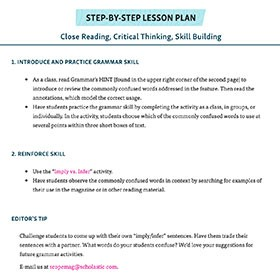
Learning objective: to correctly use the commonly confused words imply and infer
Who needs perfection anyway?
Learning objective: to make inferences about characters, then rewrite the story from another character’s perspective
A teen onboard a spaceship receives a mysterious message and faces an impossible choice.
Learning objective: to write an expository essay analyzing structure and author’s craft in a work of fiction
Grammar Has a Laugh: Nina design/Shutterstock.com (Emojis); Nathaniel Welch/Redux for Scholastic Inc. (Girl); All the Right Notes: Sebastian Crocker/Shutterstock.com (saxophone); Shutterstock.com (music notes); The Message: Shane Rebenschied