
What if you could travel back in time to the year 80,000 B.C.? You’d get to explore a very different world. You might see a saber-toothed cat stalking its prey or a 10-foot-tall woolly mammoth lumbering across an icy plain.
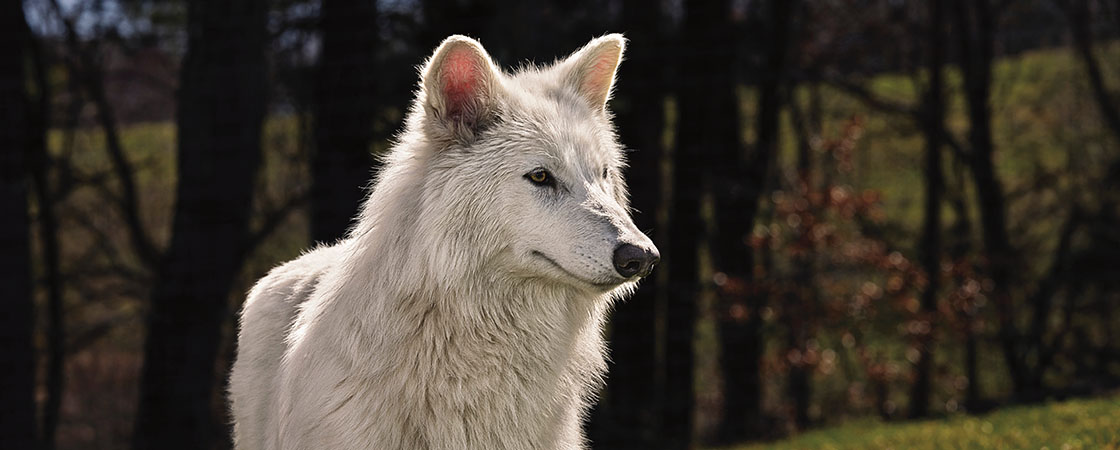
Or you might encounter one of the most fearsome creatures ever to prowl Earth: the dire wolf. Standing around 3 feet tall and weighing as much as 150 pounds, these canines had massive jaws filled with giant, razor-sharp teeth that could tear prey apart with deadly ease. They were among the Ice Age’s top predators.
The last of these wolves died about 13,000 years ago. But traces of them, like fossilized teeth, can still be found today.
And now, a company called Colossal Biosciences has used ancient remains of dire wolves to
bring them back. In October 2024, two wolf pups, Romulus and Remus, were born. A few months later, a third pup, Khaleesi, was born. These young wolves are not truly dire wolves, but they are similar. They are gray wolves—smaller, modern-day relatives of the dire wolf—that have been genetically altered to have dire wolf characteristics.
The birth of these wolves has triggered a debate: Is bringing back extinct animals a good idea?
Back to Teacher View
Student View
Andrew Zuckerman (dire wolf); Shutterstock.com (background)
Bringing Back the Dire Wolf
New technology could make it possible to bring back extinct animals. Is that a good idea?
By Mackenzie Carro
From the September 2025 Issue
Learning Objective: to read a short informational text, then craft a constructed response that includes a claim, text evidence, and commentary
Complexity Factors
Lexile: 990L
Featured Skill:
Constructed Response,
Other Key Skills: identifying central ideas and details
Standards

The Science
The process of bringing back extinct animals is known as de-extinction. For decades, this idea belonged more to the realm of science fiction than to actual science. But advances in technology have made de-extinction a possibility. In addition to dire wolves, Colossal hopes to bring back other long- gone species, including the woolly mammoth and the dodo bird.
To understand how de-extinction works, you have to start with genes. Genes are the parts of our cells that determine our traits—the color of our hair, the size of our feet, the shape of our noses.
To bring back the dire wolf—or something like it—scientists at Colossal studied genes extracted from a 13,000-year-old fossilized tooth and 72,000-year-old fragment of skull. The aim was to determine which genes gave the dire wolf its distinct traits, such as its light-colored fur and large size.
Once they identified those genes, the scientists collected cells from a gray wolf, the dire wolf’s closest living relative. They then edited a number of the gray wolf’s genes to make them match those of a dire wolf.
These genetically modified cells were then used to create embryos. The embryos were placed into the womb of a large dog, another close relative of the wolf. Months later, the dog gave birth to two white wolves.
Colossal Biosciences (Romulus & Remus)
Romulus’s and Remus’s genes were edited to give them dire wolf traits, such as their thick white coats, characteristic howl, and large size. As pups, the wolves were about 20 percent bigger than gray wolves their age.
In Roman mythology, Romulus and Remus were twin brothers who were raised by a wolf.
Tough Questions
Today thousands of creatures are in danger of becoming extinct. Scientists estimate that dozens of species disappear every day. Considering this, it might seem obvious that we should find a way to bring back the animals we lose.
Yet de-extinction raises tough questions. Which animals should be brought back? Where would they live? And should humans really be meddling with nature in this way?
Colossal’s wolves show just how complicated de-extinction can be. When dire wolves existed, they hunted in packs across vast, open lands teeming with prey, like wild horses and giant sloths. Today such habitats no longer exist. If Colossal’s wolves were released into the wild, they likely couldn’t survive. What’s more, if significant numbers of these wolves ever were to be released, they could cause harm. They could compete with gray wolves for food, for example, and the gray wolf is already facing threats.
This means that Colossal’s wolves won’t live in the wild. Instead, they’ll live on a 2,000-acre preserve owned by the company. Many people have questioned whether it’s fair to bring wild animals into the world as research subjects that will never be fully wild.
People have also raised concerns about the dogs that birthed Colossal’s wolves. They likely had to undergo frequent testing, which can be stressful. And gene editing is still a new technology, which means both the dogs and the wolves could face unforeseen complications.
Exciting Opportunity?
So is it a good idea to bring back extinct species? Some say yes—that it’s an exciting learning opportunity. And Colossal has claimed that the science it is developing could be used to help restore populations of endangered animals.
But some experts worry that de-extinction discourages conservation. In other words, if we can bring animals back once their numbers dwindle, people might stop caring about protecting them in the first place.
Others question spending large amounts of time and money reviving ancient species when so many animals are struggling in the present—many because of human activity.
Maybe scientists should focus on inventing time travel instead. That way, we could see any extinct creature we wanted. Stegosaurus, anyone?
Short Write: Is de-extinction a good idea?
Answer this question in a well-organized paragraph. Use text evidence.
This article was originally published in the September 2025 issue.
Audio
()
Activities
(4)
Preparing to Read
Skill-Building Activities
The Core Skills Workout
Quizzes
(1)
Answer Key
(1)
Audio
()
Activities
(4)
Preparing to Read
Skill-Building Activities
The Core Skills Workout
Quizzes
(1)
Answer Key
(1)
Step-by-Step Lesson Plan
Close Reading, Critical Thinking, Skill Building
1. Prepare to Read
(5 minutes)
Preview Vocabulary (5 minutes)
Project the Google Slides version of Vocabulary: Definitions and Practice on your whiteboard. Review the definitions and complete the activity as a class. Highlighted words: conservation, embryos, extracted, fossilized, genetically, habitats, preserve, unforeseen. Audio pronunciations of the words and a read-aloud of the definitions are embedded on the slides. Optionally, print the PDF version or share the slideshow link directly to your LMS and have students preview the words and complete the activity independently before class.
2. Read and Discuss
(20 minutes)
For students’ first read, have them follow along as they listen to the audio read-aloud, located in the Resources tab in Teacher View and at the top of the story page in Student View.
Have students read the story again.
Optionally, divide students into groups to complete the Core Skills Workout: Central Ideas and Details activity. This graphic organizer asks students to identify the central idea and supporting details of each section of the article and the central idea of the article as a whole.
3. Write About It
(20 minutes)
Have students complete the Short Write Kit. This activity can be used to guide students as they write a claim, support it with text evidence, and provide commentary in response to the prompt on page 25 in the printed magazine and at the bottom of the digital story page:
Is de-extinction a good idea? Answer this question in a well-organized paragraph. Use text evidence.
Text-to-Speech