
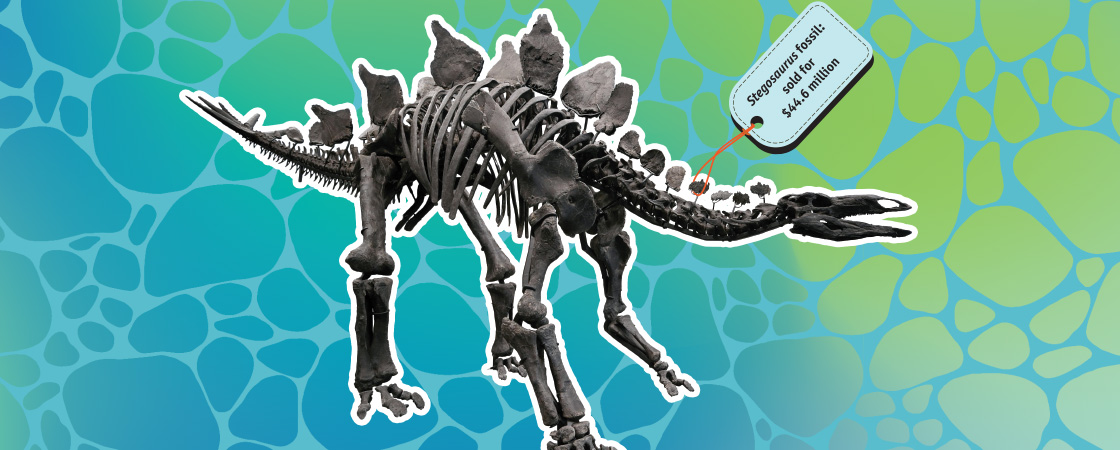
It was July 17, 2024, and a record-breaking sale was about to take place at an auction in New York City. The crowd buzzed with excitement. They were about to witness the purchase of a one-of-a-kind treasure. What was the rare find?
A 150-million-year-old dinosaur fossil.
Bidding for the fossil, a 27-foot-long Stegosaurus skeleton, started at $3 million. Over the next 15 minutes, the price climbed higher and higher as potential buyers competed for the skeleton. Ultimately, the skeleton, nicknamed Apex, sold for a staggering $44.6 million. That’s the highest price ever paid for a fossil at auction.
Surely the fossil had been bought by a museum or scientific institution that will put it on display for the public, right?
Wrong.
The ancient skeleton was bought by a billionaire from Florida.
In the U.S., such purchases are not uncommon. Here, if you find a fossil on your property, it belongs to you and—and you can sell it. Landowners can also allow fossil hunters—people who search for and dig up fossils—to look for fossils on their property. If any fossils are found and sold, the landowners and the fossil hunters share the profit.
As for the people who buy fossils, they can do whatever they want with their purchases. Wealthy collectors often display them in their homes.
Is that fair?
Back to Teacher View
Student View
Shutterstock.com (background); Anthony Behar/Sipa USA via AP Images (Stegosaurus)
Should This Skeleton Be For Sale?
In the U.S., fossils can be bought and sold. That means they can wind up in people’s homes instead of in museums. Is this right?
By Mary Kate Frank, with reporting by Talia Cowen
From the December 2024/January 2025 Issue
Learning Objective: to read and analyze a text that presents arguments on both sides of a debate, then take a stand

Key Puzzle Pieces
Alexi Rosenfeld/Getty Images
Many scientists would say no.
Why? Studying fossils helps reveal what ancient animals and plants on Earth were like. Each remnant potentially holds thrilling clues to what an animal ate or how it behaved.
But when fossils are sold to private buyers and kept in people’s homes or offices, scientists may not get the opportunity to examine them.
“It’s like hiding away a key puzzle piece that could provide valuable information about our planet’s past,” says Lara Sciscio, a scientist who studies dinosaur tracks.
And it’s not just scientists who deserve access to fossils, says Sciscio. “Fossils belong to everyone- they’re part of our Earth’s history.”
For most people, visiting a museum is the only way to view dinosaur remains in person. And without opportunities to see fossils in museums, what would inspire future generations of paleontologists?
But at auctions, museums often can’t afford to pay what wealthy private collectors can.
Hard Work
On the other hand, unearthing fossils is hard work. The precious remains are often buried in layers of rock, requiring special tools to carefully remove them. After that, the ancient rocks must be cleaned and prepared for display. For major finds, this can take thousands of hours—and a lot of money. This job is often done by fossil hunters. Some are trained scientists, while others are eager dino fans hoping to stumble on something exciting.
To make a living—and to be able to fund future searches—fossil hunters need to be able to sell their finds. If they aren’t compensated for their time and effort, many fossil hunters might not be able to continue their work. And without fossil hunters, many specimens might never be found. Or worse, they might disappear.
“There are more fossils that wash away in rainstorms every year than there are people out there to find them and properly collect them,” says Jacob Jett, a fossil hunter in Colorado.
According to Jett, if people see they can make a living from fossil hunting, more people will want to go out and search, and more fossils will be found.
And there are certainly many important fossils left to find. Scientists estimate that millions of dinosaur fossils remain undiscovered. This makes sense considering dinosaurs roamed the planet for 150 million years, leaving traces of themselves on every continent.
Sharing History
Some fairly common fossils, like teeth and eggshells, offer little new information. Maybe it doesn’t matter who buys such fossils or who has access to them.
Specimens like Apex, however, are incredibly rare. It’s among the largest and most complete Stegosaurus skeletons ever located. Perhaps the ideal compromise would be that individuals are allowed to buy fossils, but scientists and the public must be given access to noteworthy finds.
For instance, the paleontologist who unearthed Apex invited experts to examine it before the auction. And the businessperson who bought Apex has expressed interest in loaning the skeleton to a museum. So maybe you will get a chance to see it after all.
What does your class think?
Should individuals be able to buy and sell fossils?
Should individuals be able to buy and sell fossils?
Should individuals be able to buy and sell fossils?
0%
0votes
{{result.answer}}
Total Votes: 0
This article was originally published in the December 2024/January 2025 issue.
Audio
()
Activities
(7)
Preparing to Read
Reading and Discussing
Reference
Skill-Building Activities
Answer Key
(1)
Audio
()
Activities
(7)
Preparing to Read
Reading and Discussing
Reference
Skill-Building Activities
Answer Key
(1)
Step-by-Step Lesson Plan
Close Reading, Critical Thinking, Skill Building
1. Prepare to Read
(5 minutes)
Preview Vocabulary (5 minutes)
Project the Google Slides version of Vocabulary: Definitions and Practice on your whiteboard. Review the definitions and complete the activity as a class. Highlighted words: auction, compensated, paleontologists, remnant, specimens. Audio pronunciations of the words and a read-aloud of the definitions are embedded on the slides. Optionally, print the PDF version or share the slideshow link directly to your LMS and have students preview the words and complete the activity independently before class.
2. Read and Discuss
(45 minutes)
Read the article once as a class. Optionally, for students’ first read, have them follow along as they listen to the audio read-aloud, located in the Resources tab in Teacher View and at the top of the story page in Student View. Then have students silently reread the article to themselves.
Have students fill in the “Yes/No” chart in their magazines based on the details they identified in the text. Sample responses:
YES:
Fossil hunting is hard work. Fossil hunters should be able to get compensated in some way for that work.
If fossil hunters aren’t able to make money by selling their finds, they may stop fossil hunting, and then there will be fewer people out there to uncover
important fossils.
People hunting for fossils need to be encouraged to find fossils before they are washed away and lost forever.
Some fossils are not scientifically important, and there isn’t a harm in selling them.
NO:
Fossils are important pieces of history. (Answer provided.)
When fossils are sold to private buyers, scientists cannot access them. Scientists need to be able to study fossils to understand what life was like for ancient animals and plants.
Fossils are part of the history of Earth. They belong to everyone.
Museums often can’t compete with private buyers for fossils. If fossils are kept in homes rather than displayed in museums, the public can’t see them, and there are fewer opportunities to inspire future paleontologists.
Discuss: Which supporting details do you think are the strongest? The weakest? Do you think the writer shows bias—that is, a preference for one side of the debate or the other? Explain and support your answer with text evidence.
3. Write About It: What Do You Think?
(45 minutes)
Have students work individually to complete the Essay Kit, a guided writing activity and outline that will help them write their own argument essay in response to this question:
Should individuals be able to buy and sell fossils?
Students can use the Transitions and Argument Essay Checklist anchor charts to help them edit and evaluate their essays.
Text-to-Speech