
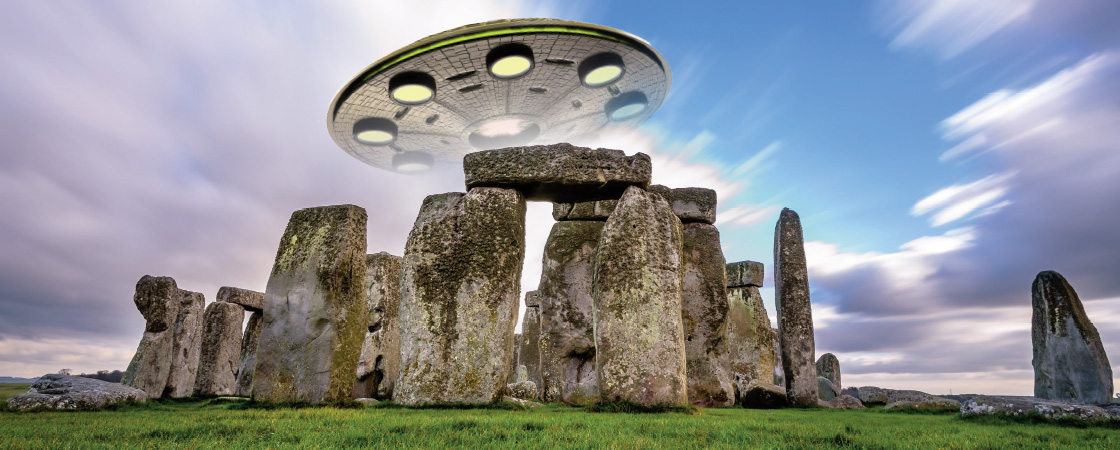
In the quiet countryside of southern England stands one of the world’s most famous archaeological sites—as well as one of its greatest mysteries: Stonehenge. In a field of rolling green hills, dozens of massive gray pillars jut up against the sky. The circular grouping of massive stones, some as tall as a two-story building, is a sight to behold.
The structure has towered over the surrounding land for more than 4,000 years, making it older than some Egyptian pyramids. During that time, wars have been fought, nations have risen and fallen, plagues have wiped out entire populations—and still Stonehenge has endured.
Back to Teacher View
Student View
Shutterstock.com
Did Aliens Make This?
Unlocking the mysteries of Stonehenge
By Jennifer Dignan
From the May 2025 Issue
Learning Objective: to read a short informational text, then craft a constructed response that includes a claim, text evidence, and commentary
Complexity Factors
Lexile: 1000L
Featured Skill:
Constructed Response,
Other Key Skills: identifying central ideas and details
Standards

Shrouded in Mystery
But what is Stonehenge exactly? And how did it get there? The answers are shrouded in mystery.
Was it assembled by giants and spirited across the sea by the wizard Merlin, as one medieval legend claims? Did ancient people construct the monument as a scientific observatory for following the movement of the stars and predicting the changing of the seasons? Was it used as a sacred place of healing? Or perhaps as a temple for the dead? Or, most thrilling of all, could Stonehenge have been built by aliens as a landing pad for their spaceships?
Each of these explanations has been proposed at one time or another, but the truth of Stonehenge remains stubbornly elusive. (It’s safe to say that aliens and wizards had nothing to do with it, however.)
For centuries, scientists have been studying Stonehenge to try to understand its origins. One of the most captivating mysteries researchers are exploring today has to do with the arrangement of the pillars. The stones are positioned in two rings, one inside the other. Curiously, the center stones perfectly frame the rising sun at the summer solstice, the longest day of the year, and the setting sun at the winter solstice, the shortest day of the year. Why? One leading theory is that the pillars were used for ancient religious ceremonies that coordinate with the seasons. Another theory is that they were used as a sort of calendar.
Jim McMahon/Mapman ®
A Grueling Task
Scientists are also looking into the question of how the pillars got there in the first place. These pillars are, after all, gigantic.
The pillars in the outer ring are formed out of sarsen, a type of sandstone, and each weighs around 25 tons, about as much as a humpback whale. Experts believe they came from a site about 20 miles away. The inner stones, made from a type of bluestone, each weigh from 2 to 5 tons, as much as an African elephant. They are believed to have mostly come from southwestern Wales, some 140 miles away. (It would take about 48 hours—without stopping to rest or sleep—to travel that distance on foot.)
How could ancient humans have moved such enormous stones across such great distances? They had no modern equipment, like trucks or cranes. They didn’t even have the wheel. The invention did not arrive in the British Isles until after Stonehenge’s construction.
One possibility is that teams of people and oxen dragged the stones over land on massive wooden sleds that were greased with animal fat to help them slide. Some of the stones may also have been placed on rafts and floated on rivers for part of the journey.
Transporting the stones would have been a grueling task—which would have been followed by the painstaking job of shaping them with handheld tools and then setting them into place. Research shows that construction occurred in several stages and continued over many centuries. Some experts estimate that the structure took more than 20 million working hours to complete.
© Historic England Archive
This illustration shows one way ancient humans may have constructed Stonehenge.
New Discoveries
Experts are continuing to make new discoveries about Stonehenge. For example, evidence of shrines and burial sites have been found throughout the area, which supports the theory that Stonehenge was used for religious purposes. And in 2024, research revealed that a stone known as the Altar Stone, which lies at the center of the monument, came from northern Scotland, a staggering 450 miles away.
Despite the new clues that have been uncovered, much about Stonehenge remains unknown. In truth, we will never unlock all of Stonehenge’s secrets. After all, those who built it had no written language—and the stones certainly aren’t talking.
Short Write: What makes Stonehenge so fascinating to so many people?
Answer this question in a well-organized paragraph. Use text evidence.
This article was originally published in the May 2025 issue.
Audio
()
Activities
(4)
Preparing to Read
Skill-Building Activities
The Core Skills Workout
Quizzes
(1)
Answer Key
(1)
Audio
()
Activities
(4)
Preparing to Read
Skill-Building Activities
The Core Skills Workout
Quizzes
(1)
Answer Key
(1)
Step-by-Step Lesson Plan
Close Reading, Critical Thinking, Skill Building
1. Prepare to Read
(5 minutes)
Preview Vocabulary (5 minutes)
Project the Google Slides version of Vocabulary: Definitions and Practice on your whiteboard. Review the definitions and complete the activity as a class. Highlighted words: elusive, grueling, observatory, spirited. Audio pronunciations of the words and a read-aloud of the definitions are embedded on the slides. Optionally, print the PDF version or share the slideshow link directly to your LMS and have students preview the words and complete the activity independently before class.
2. Read and Discuss
(20 minutes)
For students’ first read, have them follow along as they listen to the audio read-aloud, located in the Resources tab in Teacher View and at the top of the story page in Student View.
Have students read the story again.
Optionally, divide students into groups to complete the Core Skills Workout: Central Ideas and Details activity. This graphic organizer asks students to identify the central idea and supporting details of each section of the article and the central idea of the article as a whole.
3. Write About It
(20 minutes)
Have students complete the Short Write Kit. This activity can be used to guide students as they write a claim, support it with text evidence, and provide commentary in response to the prompt on page 31 in the printed magazine and at the bottom of the digital story page:
What makes Stonehenge so fascinating to so many people? Answer this question in a well-organized paragraph. Use text evidence.
Text-to-Speech